Accessories & props
Using a foam roller in Pilates
The short answer
In Pilates a foam roller is used as an unstable surface for balance and control work, and as a support for thoracic extension — not primarily for the self-massage it is best known for. Lying lengthwise on it turns almost any supine exercise into a stability challenge.
An instability tool, not a massage tool
The common use of a roller is rolling out muscles, and the evidence for that is mixed at best. In Pilates it serves a different and better-supported purpose: as a narrow, unstable surface that demands continuous postural control.
Lying lengthwise along the spine on a roller removes lateral stability entirely. Simple arm movements become genuinely challenging, and the deep stabilisers have to work continuously.
Thoracic extension
Placed crosswise under the upper back, a roller supports extension over a fixed point. For anyone who sits at a desk, this is among the most useful two minutes of their day.
Move it up and down the thoracic spine rather than extending over one point repeatedly, which concentrates the movement where it is already most mobile.
- Lengthwise under the spine — instability and control work
- Crosswise under the upper back — thoracic extension
- Under one foot — balance and foot articulation
- Between the knees — adductor engagement in bridging
- Under the pelvis — supported bridging variations
Choosing density
For instability and support work, a firm high-density roller is better — a soft one compresses and loses the shape that makes it useful. Soft rollers are aimed at self-massage comfort.
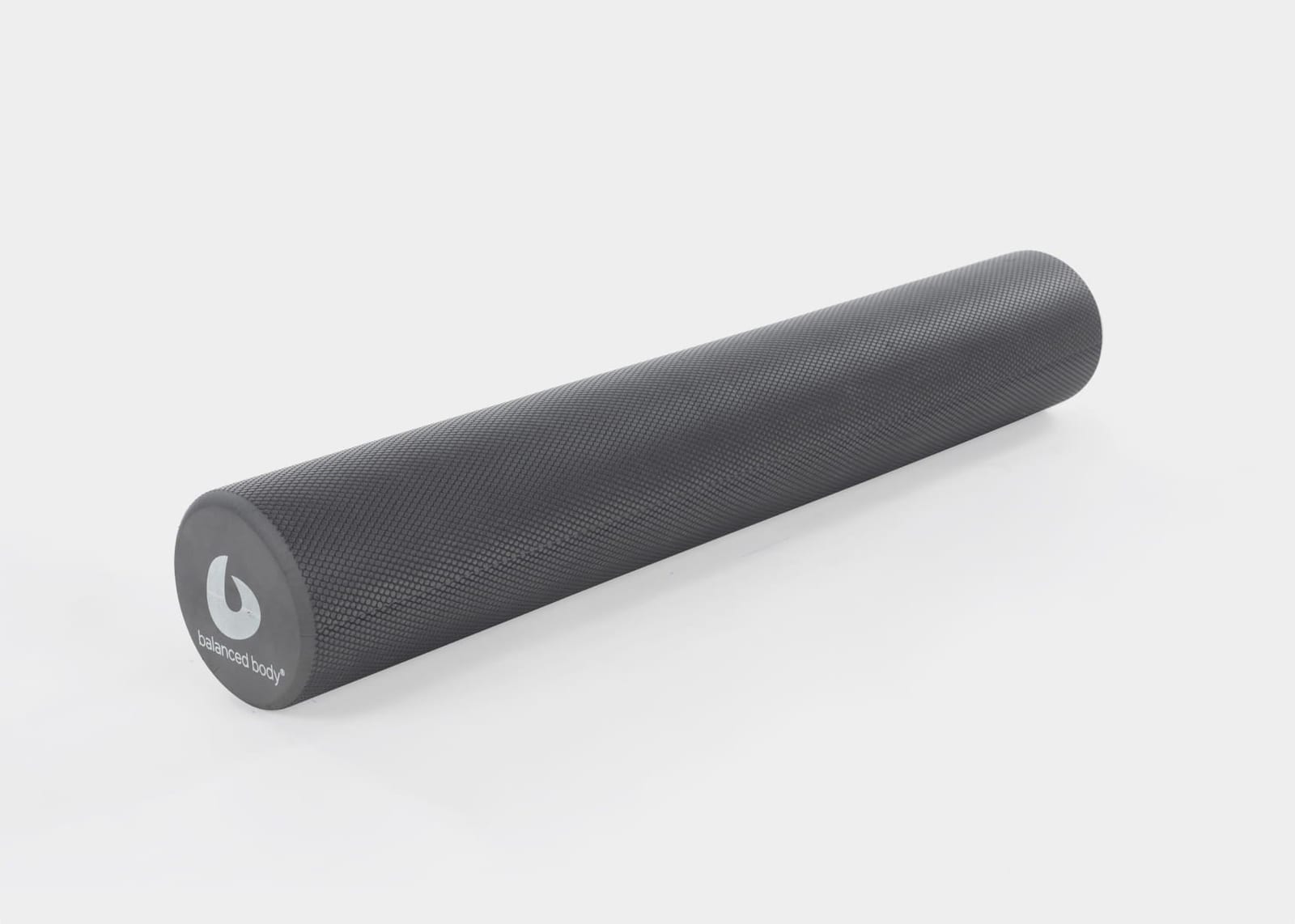
A 36 in roller supports the whole spine lengthwise; shorter ones do not, which rules out the most useful application.
What to avoid
Do not extend over a roller placed under the lower back. The lumbar spine is already the most extended region for most people, and adding a fulcrum there concentrates movement where it is least wanted.
Keep it on the thoracic spine, above the bottom of the ribcage.
Frequently asked questions
- What size foam roller for Pilates?
- A 36 inch, high-density roller. Shorter rollers cannot support the whole spine lengthwise, which rules out the most useful applications.
- Should a foam roller be soft or firm?
- Firm. For instability and support work a soft roller compresses and loses the shape that makes it useful; soft rollers are aimed at self-massage.
- Can I foam roll my lower back?
- Extending over a roller under the lower back concentrates movement where the spine is already most extended. Keep it on the thoracic spine, above the bottom of the ribs.
- Is foam rolling actually effective?
- For self-massage the evidence is mixed. In Pilates the roller is used as an instability surface and extension support, which are better-supported applications.