Accessories & props
Pilates balls and their uses
The short answer
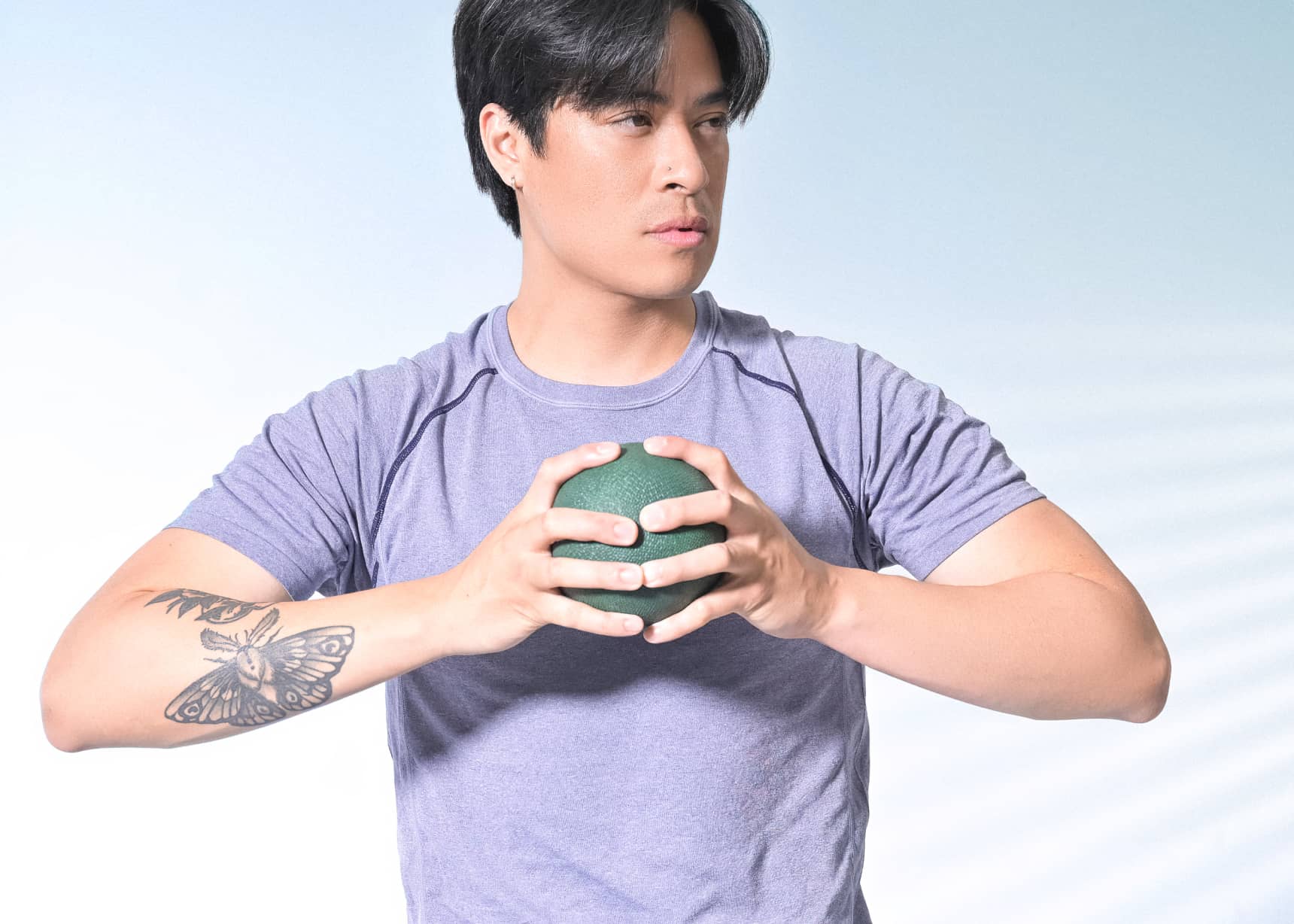
Pilates uses two ball types: a small soft ball of 20–25 cm for feedback and support, and a large stability ball of 55–75 cm sized to your height. The small ball is used far more in Pilates repertoire than the large one.
The small ball does most of the work
A 20–25 cm soft ball placed between the knees, under the pelvis or behind the lower back provides feedback and support in a way the large ball cannot. It is the ball that appears in most Pilates programming.
Its softness is the point — it compresses, so it gives proprioceptive feedback about pressure and symmetry rather than acting as a rigid support.
Sizing a large stability ball
The rule is that when you sit on it, your hips and knees should both be at roughly 90 degrees with feet flat. That maps to height fairly reliably.
| Height | Ball diameter |
|---|---|
| Under 5 ft | 45 cm |
| 5 ft to 5 ft 5 in | 55 cm |
| 5 ft 6 in to 6 ft | 65 cm |
| Over 6 ft | 75 cm |
Inflation changes behavior
A softer ball is more stable and more forgiving; a firmer one is less stable and more challenging. Both are legitimate — inflation is effectively a difficulty setting.
For the small ball, deliberately under-inflating it makes it more comfortable behind the back or under the pelvis, which is usually what you want.
Burst resistance matters
Look for a ball rated burst-resistant or anti-burst. These deflate slowly if punctured rather than failing suddenly, which matters if you are sitting on one with your feet off the floor.
Check the weight rating too — cheap balls often carry a rating well below what people assume.
Frequently asked questions
- What size Pilates ball do I need?
- For a small soft ball, 20–25 cm regardless of height. For a stability ball, size by height — 55 cm up to 5 ft 5 in, 65 cm to 6 ft, 75 cm above that.
- What is a small Pilates ball used for?
- Feedback and support — between the knees for adductor engagement, under the pelvis for bridging variations, behind the lower back for seated support.
- How firm should the ball be?
- Inflation is effectively a difficulty setting. Softer is more stable and forgiving; firmer is less stable and more challenging.
- What does anti-burst mean?
- The ball deflates slowly if punctured rather than failing suddenly. Important if you are sitting on it with feet off the floor.