Comparisons
Wunda chair vs Exo chair
The short answer
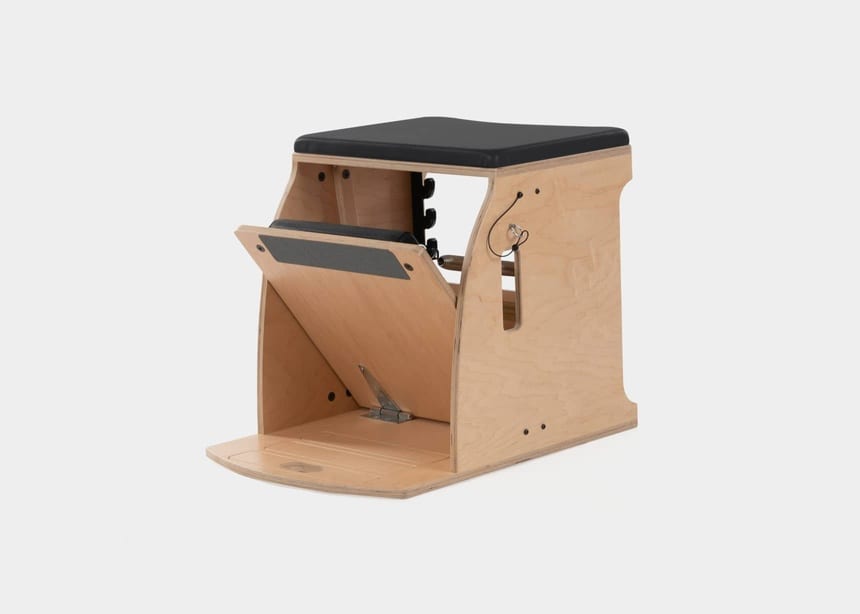
A Wunda chair is the classical design: a compact box with a single split or unsplit pedal. An Exo-style chair adds handles, a taller frame and often a split pedal with independent springs, widening the repertoire for standing and supported work at the cost of footprint.
What the classical Wunda does
The Wunda chair is deliberately minimal: a seat, a pedal and springs. That constraint is why it is such a demanding piece of apparatus — with nothing to hold, stability has to come from you. It is the smallest-footprint serious apparatus in the Pilates canon.
Split-pedal versions allow unilateral work, which matters for addressing asymmetry. Unsplit pedals are simpler and slightly cheaper.
What handles change
Adding handles transforms the chair for two groups: beginners, who gain a support point that makes standing work accessible, and clinical users, who gain a way to load the upper body against a stable base.
The cost is footprint and price. A handled chair is taller and wider, needs more clearance around it, and typically costs 30–50% more.
| Wunda chair | Handled / Exo-style chair | |
|---|---|---|
| Footprint | Smallest | Moderate |
| Repertoire | Classical, demanding | Wider, more scalable |
| Beginner access | Difficult | Much easier |
| Clinical use | Limited | Strong |
| Typical cost | Lower | 30–50% higher |
Choosing between them
For a home practitioner with existing Pilates experience and limited space, the Wunda is excellent and takes up almost nothing. For a studio teaching mixed-ability clients, the handled chair earns its footprint — it is the version most clients can actually use.
Frequently asked questions
- Is a Pilates chair worth buying?
- If you already have a reformer, a chair is the highest-value second apparatus — it adds standing and seated work in a very small footprint.
- Do I need a split pedal?
- For unilateral work and correcting asymmetries, yes. If you are buying one chair and intend to progress, split is worth the small premium.
- How much space does a Pilates chair need?
- The chair is about 2 ft square, but plan for roughly 5 ft × 5 ft of working area to allow for standing work around it.