Mechanics & specs
How a Pilates chair works
The short answer
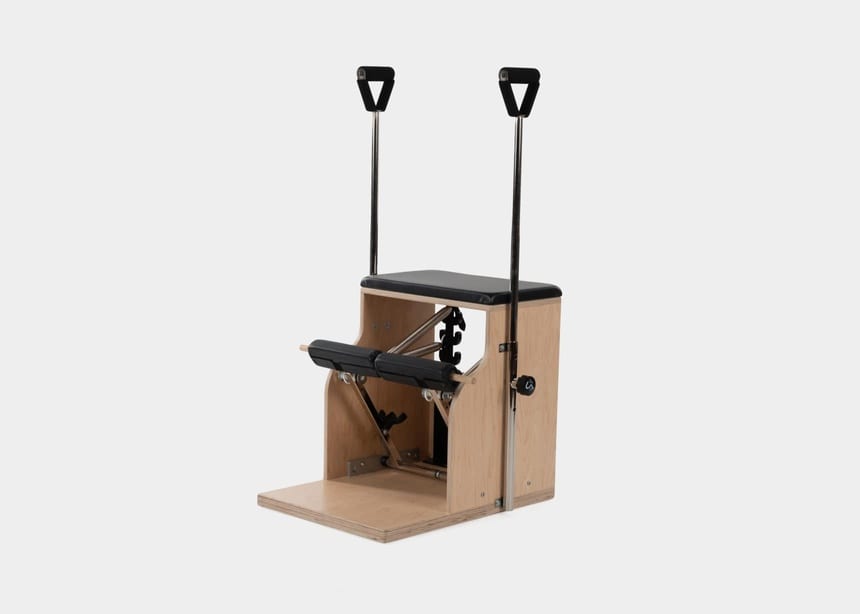
A Pilates chair uses a spring-loaded pedal hinged at the base of a compact box. Spring attachment position sets resistance and the direction of assistance. Split pedals allow each side to move independently, which is what makes unilateral work and asymmetry correction possible.
Spring position, not just spring count
On most chairs, springs attach at several heights on the frame. A higher attachment point increases resistance and changes the assistance curve through the pedal’s travel.
This gives a chair a surprisingly wide resistance range from a small number of springs, and it is why chair settings are usually written as a spring plus a position rather than a spring alone.
Split versus solid pedals
A solid pedal moves as one unit; a split pedal has two halves that move independently. The split version allows genuine unilateral loading, which is the main tool for identifying and correcting side-to-side asymmetry.
For a studio or a clinical setting this is close to essential. For a home user with no particular asymmetry, a solid pedal is perfectly workable and slightly cheaper.
| Solid pedal | Split pedal | |
|---|---|---|
| Unilateral loading | Not possible | Yes |
| Asymmetry work | Limited | Central capability |
| Clinical use | Restricted | Preferred |
| Cost | Lower | Modest premium |
Why the chair is so demanding
The chair offers a small base of support and, on classical designs, nothing to hold. Every exercise therefore has a significant stability component on top of the strength requirement.
That is the appeal and the limitation. Handled designs reduce the stability demand and make the apparatus accessible to far more clients.
Frequently asked questions
- How many springs does a Pilates chair use?
- Typically two to four, but attachment position matters as much as count — most chairs offer several heights, multiplying the available resistance settings.
- Is a split pedal worth the extra cost?
- For studio, clinical or asymmetry-focused work, yes. For general home use with a solid movement history, a solid pedal is fine.
- Why is the Pilates chair so hard?
- Small base of support and, on classical designs, nothing to hold. Every exercise carries a stability demand on top of the strength requirement.