Buying guides
Choosing commercial Pilates reformers for a studio
The short answer
A commercial Pilates reformer needs three things a home machine does not: a duty cycle rated for 8+ hours daily, fast tool-free adjustment between clients, and a published parts program so wear items can be replaced without taking the machine out of service.
Duty cycle is the real dividing line
A home reformer might see five hours a week. A studio machine in a busy timetable sees forty. That eightfold difference is what separates commercial specification from domestic: bearing life, upholstery abrasion resistance, rope wear and spring fatigue all scale with hours, not years.
This is why buying domestic machines for a studio to save money reliably costs more. The machines do not fail catastrophically; they get progressively noisier and looser, and they do it in front of paying clients.
Adjustment speed is a business metric
In a group class, you change footbar position, rope length and spring load for each client, sometimes mid-exercise. Every adjustment that needs two hands, a tool, or a client to dismount costs teaching time and breaks the flow of the class.
Look for footbars that move through their positions in one motion, rope systems that adjust under load, and spring hooks that can be changed without looking. Over a year of classes these details matter more than almost anything else on the specification.
Standardize the room
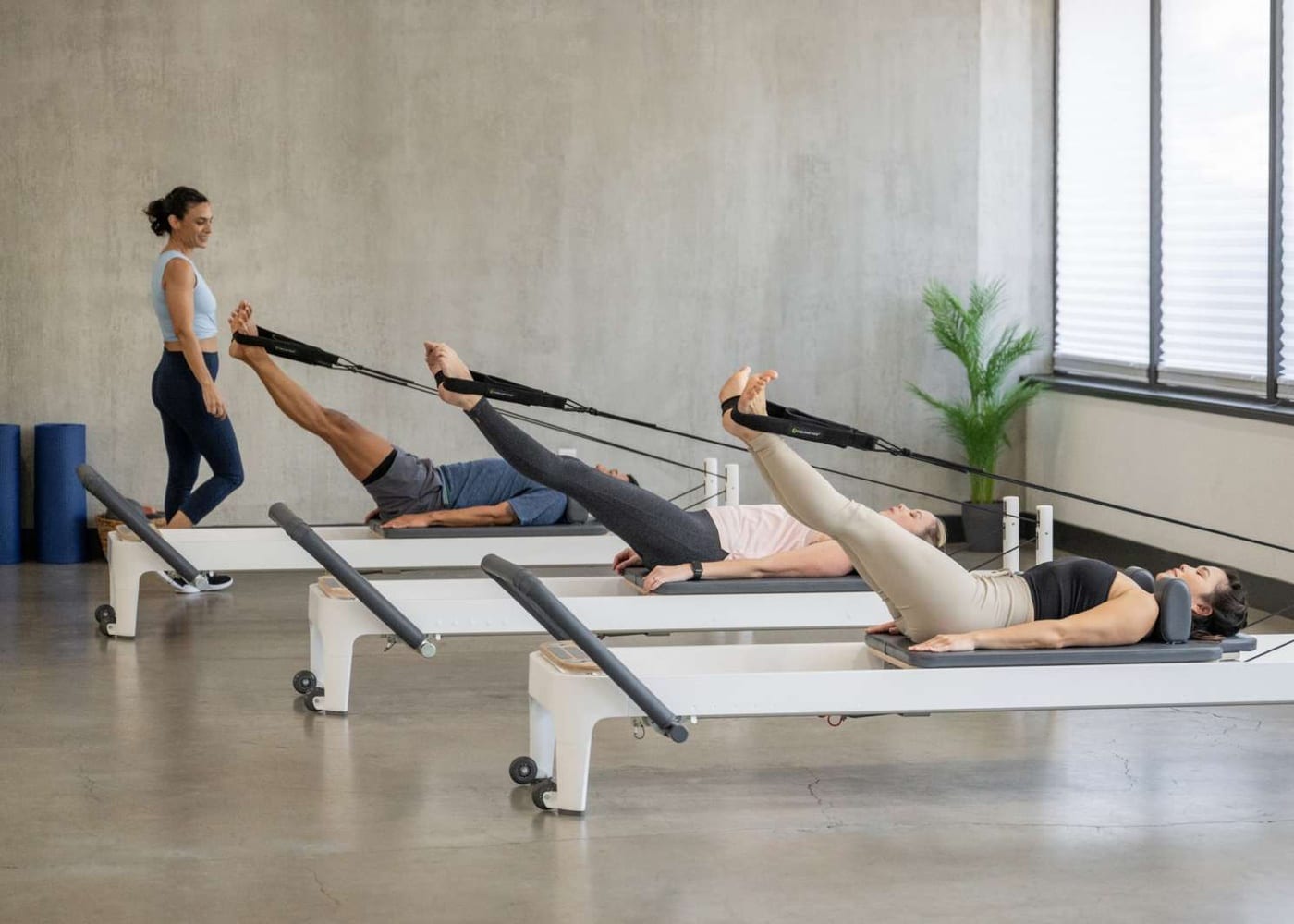
Buy identical machines. A room of matched reformers lets you teach one cue to the whole class, lets clients move between stations without relearning the equipment, and lets you hold one set of spare parts instead of several.
Mixed rooms happen when studios expand piecemeal. If you expect to grow, buy a model you can still buy in three years, and check that before you commit.
Budgeting a full room
Reformers are usually the largest single line in a studio fit-out, and quantity pricing changes the maths significantly. Our tiers apply automatically — 5% on two or more, 10% on three or more, 15% on five or more of the same machine — which on a six-station room is a meaningful share of the flooring budget.
Plan for roughly 10–12% on top of machine cost for accessories: boxes, poles, jumpboards and mats that every station needs.
Costing a room, station by station
Studio budgets go wrong when they are built from reformer prices alone. Every station needs a box, a pole, a mat and usually a jumpboard, which adds 15–20% before you have bought a single mirror.
Working in cost per fully equipped station makes the arithmetic honest and makes scaling trivial — you can price a six-station room and a ten-station room in the same breath.
| Item | Per station | × 6 |
|---|---|---|
| Studio reformer | $3,000–$5,000 | $18,000–$30,000 |
| Sitting box and pole | $150–$300 | $900–$1,800 |
| Jumpboard | $150–$350 | $900–$2,100 |
| Mat | $40–$80 | $240–$480 |
| Spare parts share | ~$100 | $600 |
| Subtotal | $3,440–$5,830 | $20,640–$34,980 |
| Less 15% quantity tier on reformers | −$2,700 to −$4,500 |
Why standardizing the room pays three times
Teaching: one cue works for the whole class, and clients move between stations without relearning the equipment. Maintenance: you hold one set of spare parts rather than several, and a failure during peak hours is a fifteen-minute fix rather than a lost class. Purchasing: identical machines reach the 15% quantity tier where a mixed order reaches nothing.
Mixed rooms almost always result from expanding piecemeal. If you expect to grow, confirm the model will still be available in three years before committing to it.
The specifications that only matter commercially
Adjustment speed is the big one. In a group class you change footbar position, rope length and spring load for each client, sometimes mid-exercise. A mechanism needing two hands or a tool costs teaching time on every adjustment, and over a year that is a substantial share of what you are paying instructors for.
The second is a published parts program. A studio without one is one failed rope away from a machine out of service for weeks, and clients notice an empty station.
- Footbar that moves through its full range in one motion
- Rope adjustment that works under load
- Spring hooks changeable without looking
- Abrasion-rated upholstery specified for daily disinfection
- Published parts list with realistic lead times
- Warranty terms that explicitly cover commercial use
Frequently asked questions
- How many reformers fit in a studio?
- Allow about 8 ft × 5 ft per station including circulation. A 900 sq ft studio comfortably holds 8–10 reformers plus a small reception and storage area.
- Do you offer discounts on multiple reformers?
- Yes — 5% off two or more of the same product, 10% off three or more, and 15% off five or more. The discount is applied automatically in the cart and shown on every product page, with no quote request.
- Should studio reformers all be the same model?
- Where possible, yes. Matched machines simplify teaching, let clients move between stations freely, and mean you hold one set of spare parts rather than several.
- How long do studio reformers last?
- Fifteen to twenty-five years of commercial use with proper maintenance, provided wear parts are replaced on schedule. The frame is rarely what ends a machine — parts availability is.
- Can I mix models in one studio?
- You can, and it costs you daily. Matched rooms simplify teaching, let clients move between stations freely, reduce spare-parts stock, and reach the quantity tiers.