Workouts & exercises
Reformer workout for flexibility
The short answer
The reformer improves flexibility through loaded stretching — using spring resistance to move into and hold a range under control. This produces more durable range gains than passive stretching because the nervous system accepts range it can actively control.
Loaded range beats passive range
Passive stretching lengthens tissue temporarily but the nervous system tends to restore the original limit within hours, because it does not consider the new range safe. Range you can actively control is range the body keeps.
The reformer is well suited to this: the spring provides both the assistance to reach a position and the resistance to work within it.
A mobility-focused session
Move through the major restrictions in order — hips, hamstrings, thoracic spine, shoulders. Hold positions for 30 seconds or work slowly through range rather than bouncing.
- Footwork through all positions — 3 springs, warms the hips and ankles
- Leg circles in straps — 1 spring, progressively larger circles
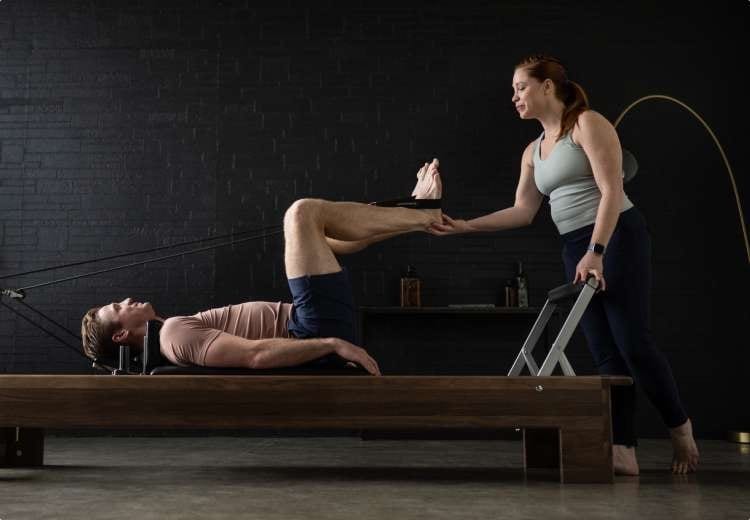
- Hamstring stretch in straps — 1 spring, 30s each side
- Elephant and down stretch — 2 springs, mobilizes hamstrings and spine
- Mermaid, seated — 1 spring, 5 breaths each side
- Arc over the carriage — 2 minutes of thoracic extension
Where the limit actually is
Most restriction that people call tightness is protective rather than structural — the nervous system limiting range it cannot control. That is why range often improves within a single session, faster than any tissue could actually lengthen.
The implication: work at the edge of comfortable range rather than pushing into pain. Forcing triggers exactly the protective response you are trying to reduce.
Frequently asked questions
- Is the reformer good for flexibility?
- Yes, and the gains tend to last better than passive stretching because you are building controlled range rather than temporarily lengthening tissue.
- How long should I hold reformer stretches?
- About 30 seconds, or work slowly through range under light spring. Bouncing triggers the protective response you are trying to reduce.
- Can Pilates help with tight hamstrings?
- Usually. Much hamstring tightness is protective rather than structural, and loaded work through available range addresses that more effectively than passive stretching.