Workouts & exercises
Reformer workout for beginners over 50
The short answer
Starting the reformer after 50 works well because the springs assist. Begin with footwork, supported bridging, seated arm work and side-lying leg series — all in positions that need no floor transfers and no loaded spinal flexion.
Why the reformer suits later starters
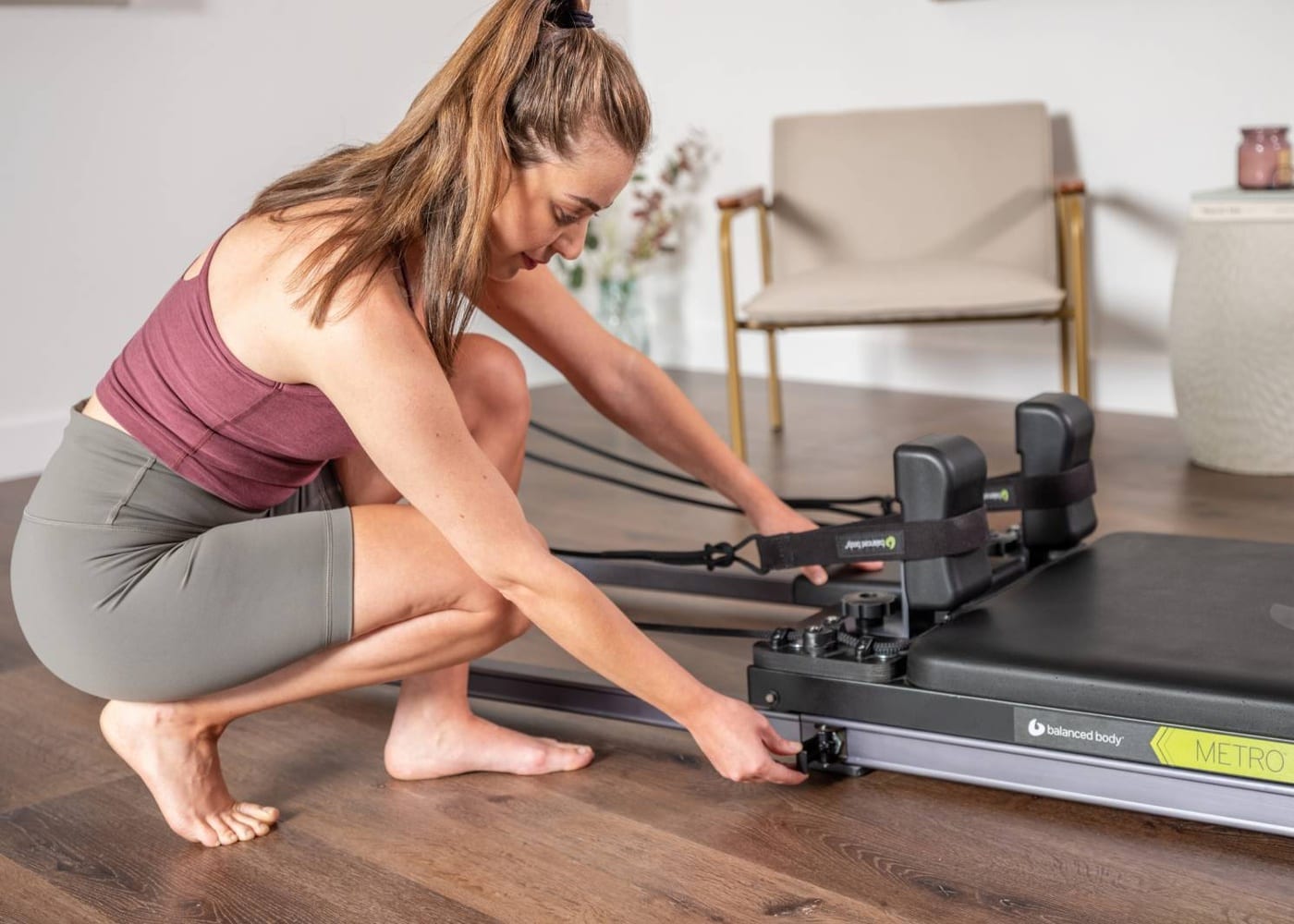
Getting down to and up from the floor is the barrier that stops many people over 50 doing mat-based exercise. A reformer carriage sits at roughly chair height, which removes that entirely.
The springs also assist. Movements that require strength you have not built yet become achievable with support, which means you can start training the pattern immediately rather than working up to it.
A first sequence
Everything here happens on the carriage at chair height, with no loaded spinal flexion and no floor transfers.
- Footwork, all positions — 3–4 springs, 10 reps each
- Bridging on the footbar — 3 springs, 8 reps
- Seated arm pulls — 1 spring, 10 reps
- Side-lying leg series — 1 spring, 10 each side
- Supported roll-down at the footbar — 5 slow reps
- Hamstring stretch in straps — 30s each leg
Bone density changes the rules
If you have osteoporosis or osteopenia, loaded spinal flexion — short spine, roll-over, teaser — is generally contraindicated because of vertebral compression risk. Extension and neutral-spine work are the emphasis instead.
This is worth establishing before starting rather than after. A DEXA result changes the program substantially, and a teacher needs to know.
Frequently asked questions
- Is it too late to start Pilates at 60?
- No. The reformer suits later starters particularly well because the carriage is at chair height and the springs assist movements you have not built strength for yet.
- Is reformer Pilates safe with osteoporosis?
- With modification, yes — but loaded spinal flexion is generally contraindicated. Tell your teacher before you start, and work in extension and neutral spine.
- How often should someone over 50 do Pilates?
- Two to three times a week. Consistency produces more benefit at this stage than intensity, and recovery takes slightly longer.