Accessories & props
Reformer straps, loops and handles
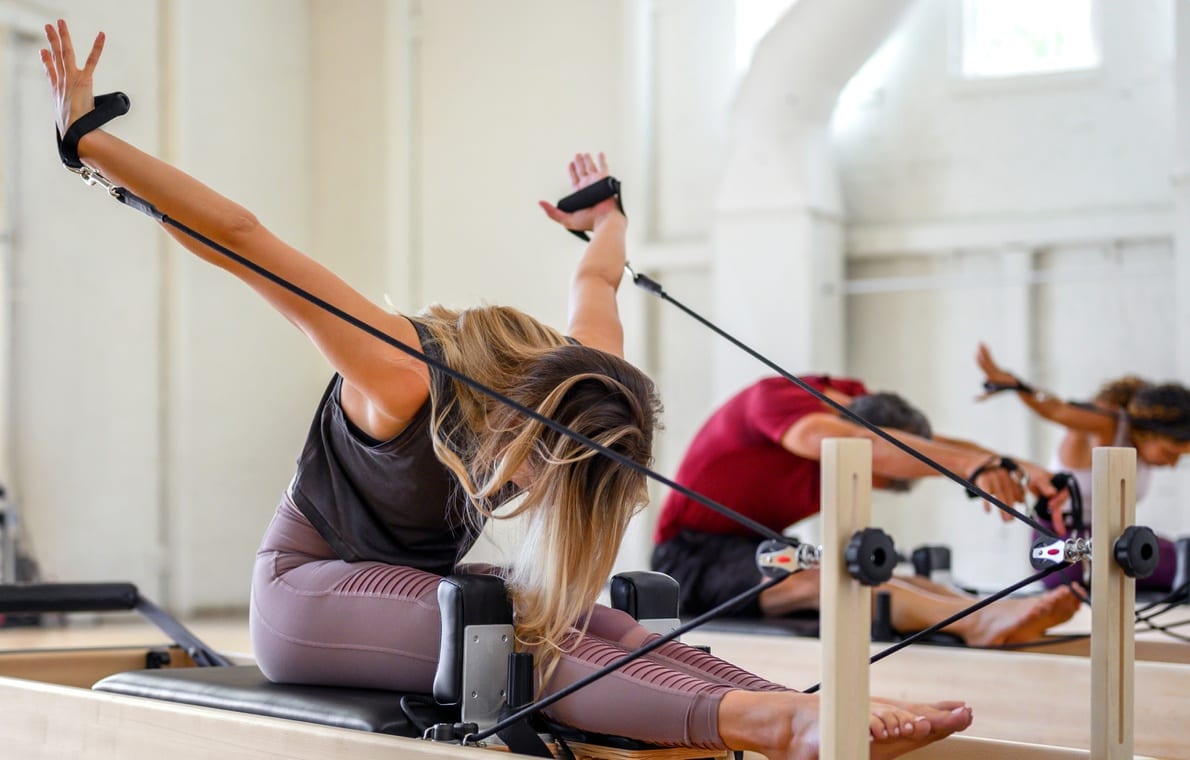
The short answer
Reformer straps attach to the ropes and come as double loops, single loops, or padded handles. Double loops suit foot work, single loops and handles suit hand work. Padded versions are considerably more comfortable for anything held for long periods.
Types and what each suits
Double loops take a foot through each opening and hold the foot securely for leg circles, frogs and openings. Single loops are simpler and work for both hands and feet. Padded handles are most comfortable for arm work where the strap presses into the hand for many repetitions.
Most studios keep at least two types on hand because the repertoire genuinely calls for different attachments.
| Type | Best for | Notes |
|---|---|---|
| Double loop | Foot work — leg circles, frogs | Most secure for feet |
| Single loop | General hand and foot work | Simplest, most versatile |
| Padded handle | Arm work, long holds | Most comfortable in the hand |
| Ankle cuff | Standing and side-lying leg work | Secures above the ankle joint |
They are wear items
Straps take the same load as ropes and wear in the same places — where they pass through hardware and where they contact the pulley. Inspect at those points and replace in pairs.
A strap failing under load releases the carriage suddenly with a client mid-exercise, so this is a safety inspection rather than a cosmetic one.
Length and adjustability
Some straps are adjustable, which lets one set suit clients of very different sizes. In a studio that saves time; at home with one user, fixed length is fine and slightly simpler.
Whichever you use, both sides must be identical in length. An asymmetry here produces a movement asymmetry that is easy to misattribute to the body.
Hygiene
Straps and handles are high-contact and absorb sweat. Fabric straps in particular need regular washing rather than wiping — they hold odour otherwise.
Check the manufacturer’s guidance on washing, since some webbing loses strength if machine-washed hot.
Frequently asked questions
- What is the difference between loops and handles?
- Loops are simple webbing openings for hands or feet; handles are padded grips. Handles are more comfortable for arm work held over many repetitions.
- How often should straps be replaced?
- Inspect where they pass through hardware and over pulleys, and replace in pairs when wear appears. A strap failing under load releases the carriage suddenly.
- Do straps need to be the same length on both sides?
- Yes. An asymmetry produces a movement difference that is easy to misattribute to the client’s body rather than the equipment.
- How do I clean reformer straps?
- Fabric straps need washing rather than wiping, since they absorb sweat and hold odour. Check the manufacturer’s guidance — some webbing weakens if washed hot.