Workouts & exercises
Reformer exercises for runners
The short answer
Runners benefit most from single-leg loading, hip stability and thoracic rotation on the reformer. Single-leg footwork, side-lying series, and rotation work address the three things that break down over distance: hip stability, glute endurance and arm-swing mechanics.
Running is a single-leg sport
Every stride is a single-leg landing and push-off, yet most runners’ supplementary training is bilateral. Two-legged exercises let the stronger side compensate, which is exactly the imbalance that produces injury over high mileage.
Single-leg footwork on the reformer loads one leg at a time in a controlled range, which is why it appears in so many running rehabilitation programs.
A runner-focused session
Emphasis on unilateral loading and lateral hip control. Twice a week alongside running is enough.
- Single-leg footwork — 2–3 springs, 10 each leg
- Side-lying leg series — 1 spring, 12 each side
- Single-leg bridging — 2 springs, 8 each side
- Standing lunge on the carriage — 1 spring, 6 each side
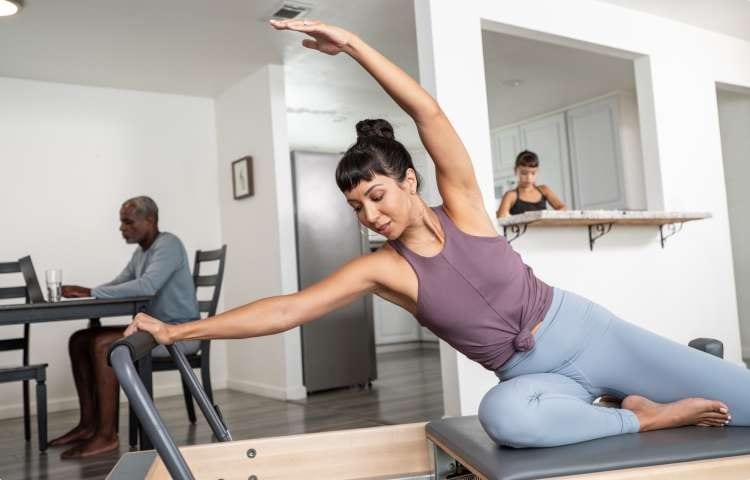
- Mermaid and rotation work — 1 spring, 5 each side
- Hamstring stretch in straps — 1 spring, 30s each
The lateral hip is where it usually fails
Gluteus medius endurance determines whether the pelvis stays level through the stance phase. When it fatigues, the pelvis drops on the swing side and the knee falls inward — the mechanism behind much of runner’s knee and IT band pain.
Side-lying work trains it directly, and endurance matters more than strength here: high repetitions at light load beat heavy sets.
Frequently asked questions
- Should runners do Pilates?
- It addresses hip stability and single-leg control better than most supplementary training, and those are the qualities that break down over distance.
- How often should a runner do Pilates?
- Twice a week alongside running. Schedule it away from key sessions, since it fatigues the stabilisers running depends on.
- Can Pilates help runner’s knee?
- Frequently, by addressing the lateral hip weakness that lets the knee fall inward. It is a common component of rehabilitation for the condition.