Space & setup
Setting up Pilates in a small apartment
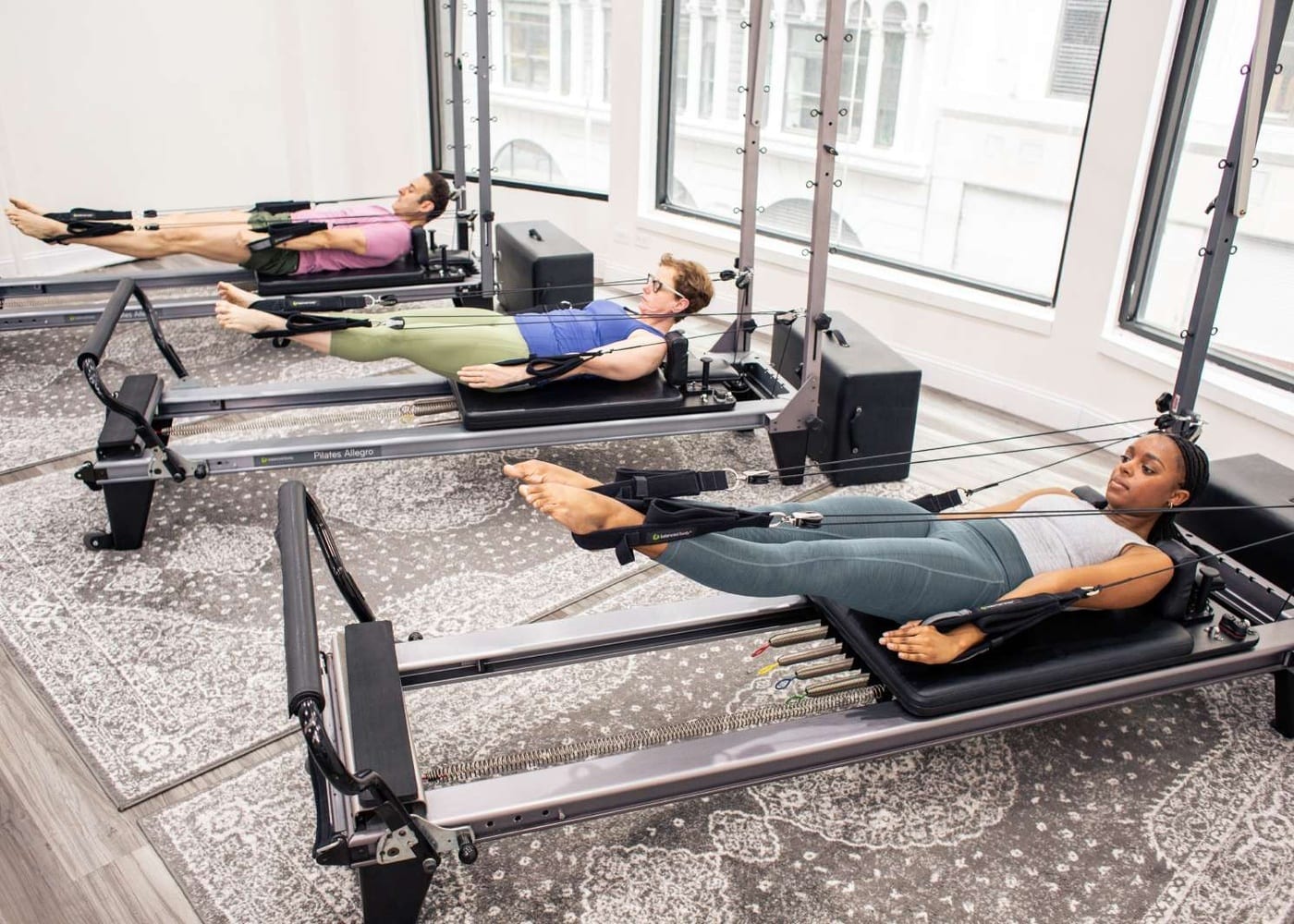
The short answer
In an apartment, choose equipment by stored footprint rather than set-up footprint. A folding or upright-storing reformer needs about 2 ft × 2 ft of parked floor space, and a Pilates chair needs about the same while offering a genuinely demanding workout.
Stored footprint is the real constraint
You will use the machine for perhaps an hour a day. For the other twenty-three it needs to not dominate the room. That makes stored dimensions, not set-up dimensions, the number to plan around.
A full-length reformer that stands on end parks in about 2 ft × 2 ft against roughly 8 ft of wall. A folding one parks in about 2 ft × 4 ft flat. Both are apartment-viable; a fixed 8 ft frame usually is not.
Noise and neighbours
In an apartment this is a genuine constraint, not a nicety. Carriage noise transmits through floors, and jumping work transmits a great deal. A dense mat under the frame helps substantially; avoiding jumpboard work in a shared building helps more.
Quality of bearings matters more here than anywhere. A machine that is quiet in a showroom is quiet through a floor.
The chair alternative
If a reformer genuinely will not fit, a Pilates chair is the strongest alternative. It occupies about 2 ft square permanently, needs roughly 5 ft × 5 ft of working area, and is a demanding piece of apparatus rather than a compromise.
Paired with a mat, a chair covers more of the repertoire than most people expect — and it never needs to be folded away.
Frequently asked questions
- What is the best Pilates equipment for an apartment?
- A folding or upright-storing reformer if you have a clear 10 ft × 6 ft to set up in; a Pilates chair if you do not.
- Will my neighbours hear my reformer?
- Possibly, through the floor. A dense mat under the frame and good carriage bearings reduce it a lot. Jumpboard work will be audible regardless.
- Can I do reformer Pilates in a living room?
- Yes, if you can clear about 10 ft × 6 ft during use. Upright storage against a wall makes this practical in most living rooms.