Accessories & props
Reformer tower accessories
The short answer
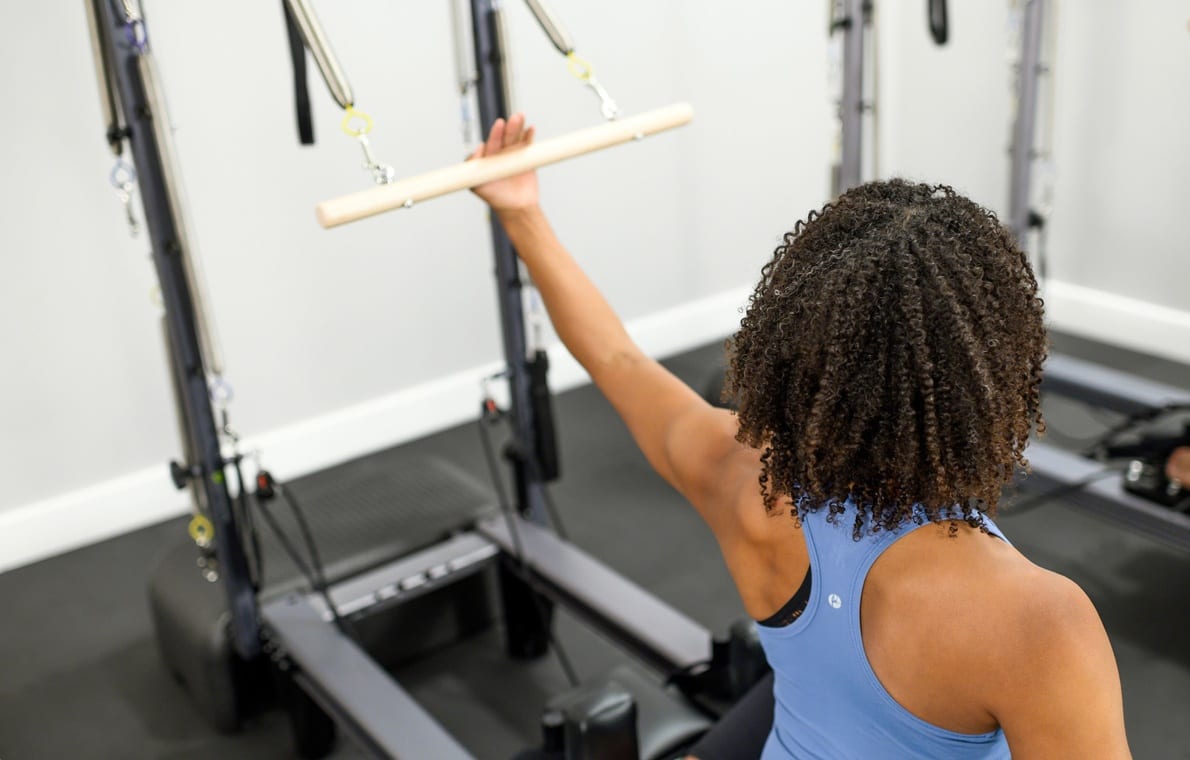
A tower’s core attachments are the push-through bar, roll-down bar, and leg and arm springs. The push-through bar delivers most of the value; the roll-down bar and additional spring sets extend the repertoire further, particularly for rehabilitation work.
The push-through bar is the main event
It travels through an arc and can be loaded from above or below. Loaded from above it resists pressing; loaded from below it assists lifting. That reversal is what makes it so useful for spinal articulation work.
If a tower comes with only one attachment, this is the one, and it accounts for most of what people buy a tower for.
Roll-down bar and springs
The roll-down bar hangs on springs from the top of the frame and supports controlled spinal flexion — the standard use is teaching a roll-down with assistance that the mat cannot give.
Leg springs and arm springs attach at various heights and cover most of the remaining repertoire, from supine hip work to standing arm patterns.
- Push-through bar — spinal articulation, shoulder mechanics
- Roll-down bar — assisted flexion and control
- Leg springs — supine and side-lying hip work
- Arm springs — seated, standing and supine upper body
- Safety strap — required for any suspended work
Spring gradation on a tower
Tower springs come in several tensions and attach at multiple heights, and both variables change the resistance. This gives a wide range from a small number of springs but also means settings need to be recorded as spring plus height.
For teaching, keep a written note of client settings. "Yellow spring" is not a setting on a tower; "yellow at the third hole" is.
What to buy with the tower
The push-through bar and one set of leg and arm springs cover the great majority of use. Roll-down bars and additional spring sets are worth adding once you know which parts of the repertoire you actually teach or train.
A safety strap is not optional if anyone will hang from the frame.
Frequently asked questions
- What does a push-through bar do?
- It travels through an arc and can be loaded from above or below — resisting pressing or assisting lifting. It is the main attachment on any tower.
- Do I need a roll-down bar?
- It is useful for teaching assisted spinal flexion but not essential. The push-through bar and one set of leg and arm springs cover most use.
- How do I record tower spring settings?
- As spring plus attachment height. Because resistance depends on both, a color alone does not identify a setting on a tower.
- Is a safety strap necessary?
- For any hanging or suspended work on the frame, yes. It is not optional equipment.