Buying guides
Pilates reformer buying guide
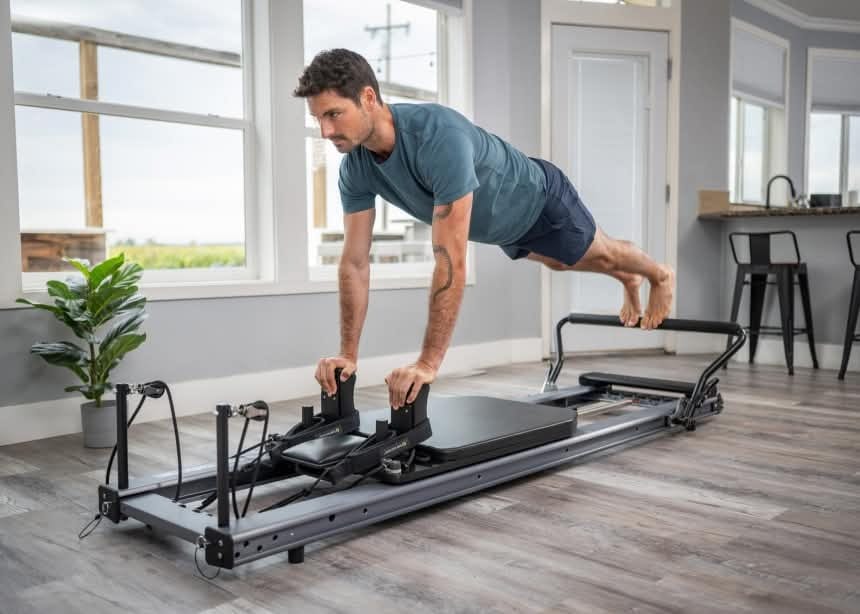
The short answer
Choosing a Pilates reformer comes down to six things: frame material and rigidity, carriage bearing quality, spring gradient, footbar adjustability, maximum user weight, and whether wear parts can be replaced. Everything else — color, branding, bundled accessories — is secondary to those six.
Start with the frame, not the price
The frame determines whether a reformer is still square in year eight. Maple and beech hardwood frames are stiff, heavy and quiet; anodized aluminum frames are lighter, immune to humidity swings and easier to move; powder-coated steel sits between the two on cost and above both on weight. What matters more than the material is the section thickness and how the joints are made — a thin aluminum extrusion with bolted corners will develop play long before a properly jointed hardwood frame will.
A useful test at a showroom: push the frame diagonally at one corner. A rigid frame resists as a single object. A frame with weak joinery flexes, and that flex becomes rattle once the carriage is loaded and moving.
Carriage glide is a bearing question
Everything people describe as "smooth" or "quiet" in a reformer is really the bearing system. Sealed precision bearings running on machined rails stay quiet for years and resist dust. Open bushings or unsealed wheels are cheaper, louder within months, and pick up grit that scores the rail.
Check side-play by grabbing the carriage and rocking it laterally at both ends of its travel. A well-made carriage has almost none, at either end. Play at the far end of travel — where the wheels are least supported — is the earliest sign of a carriage that will get noisy.
Springs: gradient matters more than count
Spring count is a marketing number. What matters is the gradient across the set — whether you can make small, even jumps in resistance rather than one large one. A set of five springs that goes light, light, medium, medium, heavy gives you far more usable combinations than four springs that jump straight from light to heavy.
For teaching, that gradient is the difference between being able to place a client correctly and having to compromise. For home use it decides whether you outgrow the machine in a year.
| Spring set | Usable combinations | Best for |
|---|---|---|
| 4 springs, 2 tensions | Limited — large jumps | Occasional home use |
| 5 springs, 3 tensions | Good — small increments | Serious home, light studio |
| 5 springs, 4+ tensions | Wide — fine control | Group classes, rehab, mixed ability |
The specification most listings omit
Maximum user weight is the number most reformer listings leave out, and it is the one that determines who can safely use the machine. Studio-rated reformers typically carry 300–350 lb ratings. Lightweight folding machines are often rated far lower, sometimes 220 lb, which quietly excludes a significant share of adults.
If a listing does not publish a weight rating, treat that as the answer rather than an oversight.
Serviceability decides the real cost
Ropes stretch, springs fatigue, upholstery splits and wheels flat-spot. On a machine running several classes a day, all of that is normal wear within a few years. The question is whether those are parts you can order, or whether their failure ends the machine.
Before buying, look for a published parts list. A manufacturer that sells replacement springs, ropes, wheels and upholstery separately is telling you the machine is designed to be maintained. One that does not is telling you the opposite.
How to test a reformer in ten minutes
If you can get to a showroom, these checks tell you more than any specification sheet. Push the frame diagonally at one top corner — a well-jointed frame moves as a single object, a poorly jointed one flexes at the joints and you will feel the give before you see it.
Then grab the carriage and rock it laterally at both ends of its travel. Near-zero movement is what you want, and the far end matters most because that is where the wheels are least supported. Any play there is the earliest sign of a carriage that will get noisy.
Finally, detach the springs and push the carriage slowly through its full travel, listening. A gritty sound throughout means debris or a poor rail finish. A tick at the same point every stroke means a wheel. Silence is what a good machine sounds like.
Questions to ask before you order
Manufacturers publish the specifications that flatter them, so the gaps in a listing are usually where the answers are. These are the questions worth asking directly, and a supplier who cannot answer them is telling you something about what happens when you need a part in five years.
- What is the maximum user weight, and where is it published?
- What bearing type does the carriage run on — sealed or bushing?
- What is the carriage travel in inches?
- Are springs, ropes, wheels and upholstery sold as replacement parts?
- Is this model tower-ready, and can a tower be retrofitted later?
- Does the warranty change if the machine is used commercially?
- What is the freight cost, and is delivery curbside or to the room?
Matching the machine to how you will actually use it
The most expensive mistake in this category is buying for an imagined practice rather than a real one. Someone training twice a week at home needs a rigid frame, sealed bearings and available parts — they do not need a commercial duty cycle or tool-free adjustment designed for changing between eight clients an hour.
Conversely, a studio buying domestic machines to save money reliably spends more. Those machines do not fail dramatically; they get progressively looser and noisier over eighteen months, and they do it in front of paying clients.
Be honest about frequency, number of users, and whether the machine will move. Those three answers narrow the field faster than any feature comparison.
| Use case | Prioritize | Can compromise on |
|---|---|---|
| Home, 1–2 users | Frame rigidity, bearings, parts | Duty cycle, adjustment speed |
| Home, teaching a few clients | Weight rating, adjustment range | Commercial duty cycle |
| Studio, group classes | Duty cycle, fast adjustment, parts program | Finish, color options |
| Clinical | Low-end spring gradation, transfer height | Advanced repertoire features |
| Mobile teaching | Weight, folding mechanism | Tower compatibility |
Frequently asked questions
- How much should I spend on a Pilates reformer?
- Home reformers that are genuinely worth owning start around $1,500–$2,500. Studio-grade machines built for group-class duty run $3,000–$6,000. Below roughly $1,000 you are usually buying a frame that will develop play and parts you cannot replace.
- Is a wood or aluminum reformer better?
- Neither is inherently better. Hardwood is stiffer and quieter and suits a permanent studio installation; aluminum is lighter, unaffected by humidity and easier to move or stack. Build quality within each material varies far more than the difference between them.
- Do I need a tower with my reformer?
- Not to begin with. A tower adds standing and supine spring work and roughly doubles the exercise repertoire, but it also needs ceiling height and wall clearance. Most buyers are better served by a well-specified reformer than a cheap reformer plus tower.
- How long does a Pilates reformer last?
- A well-made frame lasts decades. What limits life is parts availability — a machine you can re-spring, re-rope and re-upholster has no natural end, and one you cannot has perhaps a decade.
- Should I buy the reformer and tower together?
- Buy a tower-ready reformer even if you add the tower later. Most machines cannot be retrofitted, so it is the one decision that has to be made at first purchase.